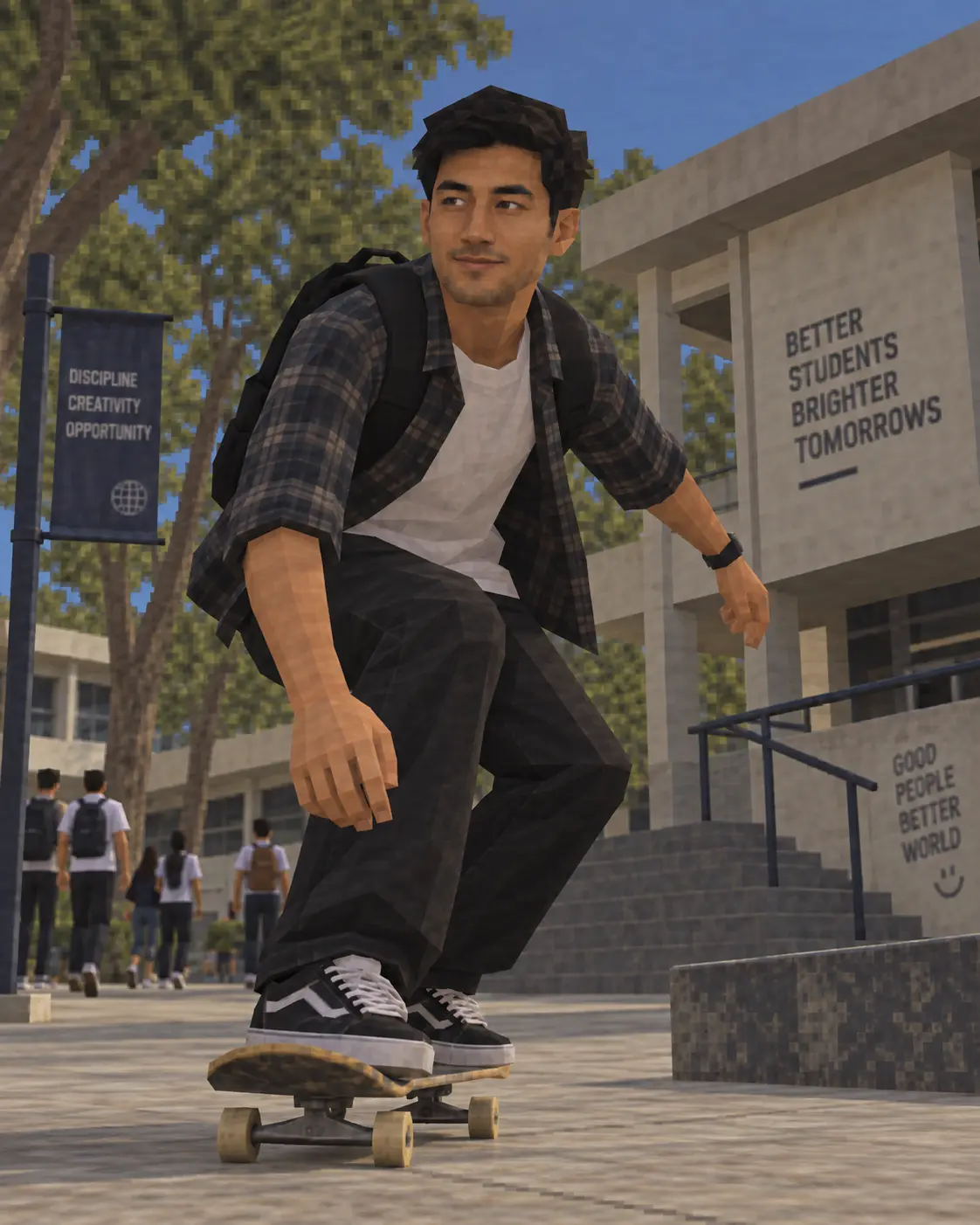
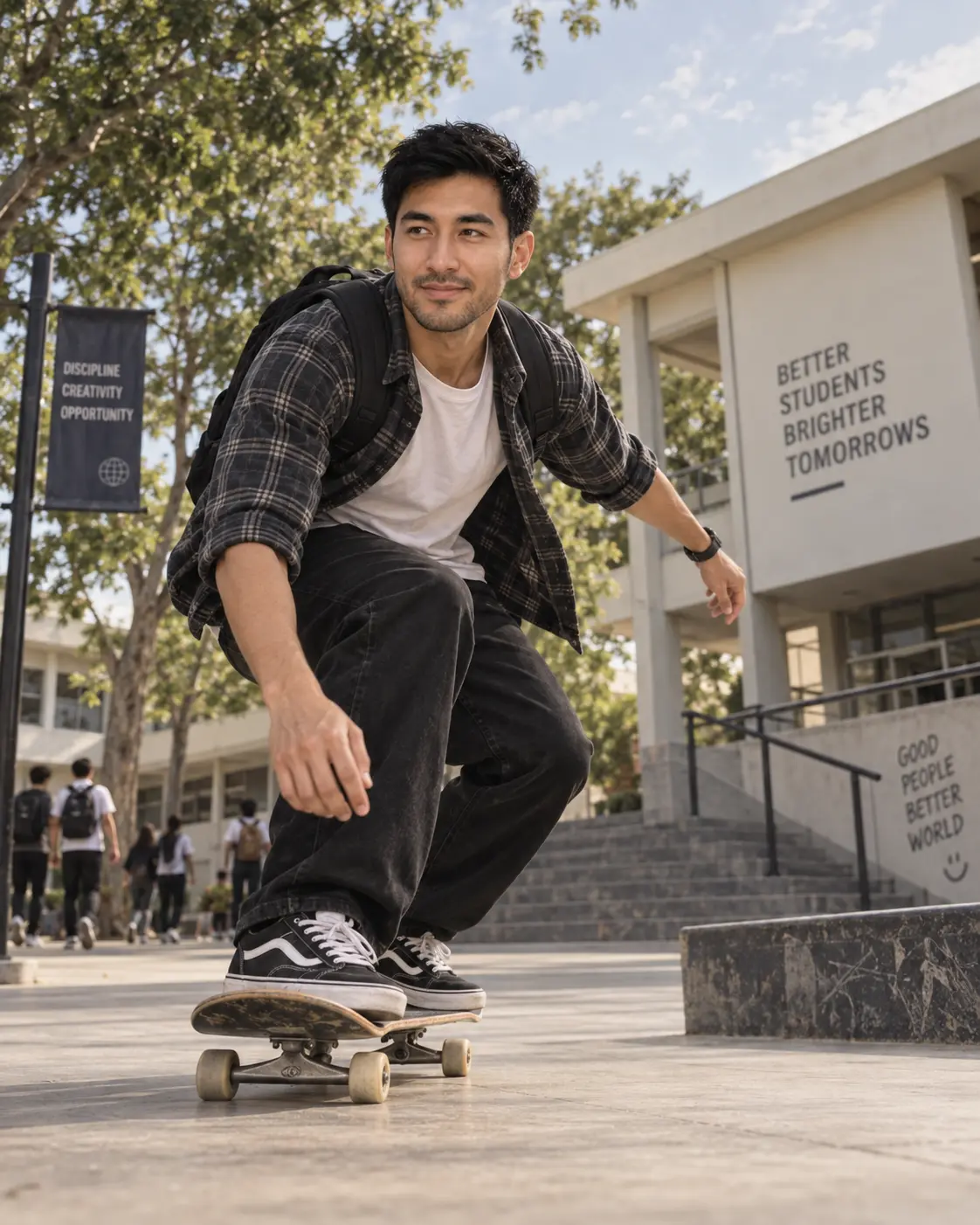
Convert the uploaded photo into a 3D character render using the exact rendering technique of a PlayStation 2-era game engine (technically identical to the Bully / Canis Canem Edit engine, 2006 Rockstar Vancouver) — replicate ONLY the render style/technique itself. This is a style conversion, not a re-imagining: every object, person, pose, and background element in the uploaded photo must be preserved exactly as-is, just re-rendered in low-poly 3D. Do not add, remove, relocate, resize, or redesign anything — no invented props, no changed clothing design, no altered background layout, no new characters or objects that weren't in the original photo.

STYLE (apply to the ENTIRE subject AND background, face included): low-polygon mesh with slightly stylized, gently exaggerated proportions typical of that PS2 engine generation — a touch of exaggeration in head/feature size compared to strict realism, but still built from visibly blocky, low-vertex geometry. Flat-shaded skin with minimal gradient and low-resolution texture mapping (visible pixelation/texture blur up close, slightly saturated color, no subsurface skin detail). Hair is a simplified solid low-poly shape with flat baked-on texture, not individual strands. Clothing keeps its exact real-world design (same garments, same colors, same patterns, same accessories as the photo) but rendered with stiff, angular, low-vertex fabric folds and flat matte texture fills — no fine woven detail, no realistic draping physics. Eyes are simple flat-shaded low-poly shapes with a small flat specular highlight. Lighting is flat, low-dynamic-range in-game lighting with hard-edged simple shadows, no ambient occlusion, no cinematic bloom or bokeh — this must read as an actual PS2-era game screenshot, low fidelity by today's standards.

FACIAL ANCHOR LOCK: rebuild the subject's real facial identity (face shape, features, skin tone, hairstyle silhouette) fully within this low-poly style — the face must NOT be rendered in a higher, more realistic fidelity than the body. Identity must stay structurally recognizable through the stylization, with zero visible seam or fidelity mismatch at the hairline, jaw, or neck.

POSE & COMPOSITION: keep the subject's exact pose, gesture, camera angle, framing, and position in the frame identical to the uploaded photo. If more than one person appears, keep their exact relative positions and interaction unchanged.

ENVIRONMENT: rebuild the background exactly as it appears in the uploaded photo — same architecture, same objects, same layout, same spatial arrangement — re-rendered with the same blocky low-poly geometry and low-res textures as the subject. Nothing in the background may be invented, substituted, or omitted; if a background element is unclear in the photo, render your best literal interpretation of it rather than replacing it with something else.

ANATOMY LOCK: exactly 5 fingers per hand with natural knuckles and a 2-jointed thumb (simplified to low-poly geometry but still countable and correct), 1:7 head-to-body ratio, natural shoulder width, arms reaching mid-thigh — anatomically correct proportions preserved even within the stylization.

Gender-neutral styling language throughout.

Fix protocol: if hands or body proportions render incorrectly, regenerate only the hands/body — never alter the locked facial identity, and never alter any object or element that was correctly preserved elsewhere in the image.

Negative prompt: no added, removed, or redesigned objects/props/clothing/background elements, no characters or iconography from any specific existing video game, no high-fidelity or realistic skin/hair rendering on the face, no photorealistic textures anywhere, no extra fingers, no melted/warped geometry, no mismatched fidelity between face and body, no visible cutout/paste seam at hairline or neck, no cinematic lighting/bloom/depth-of-field, no UI elements, no inset thumbnails, no text or watermarks of any kind.