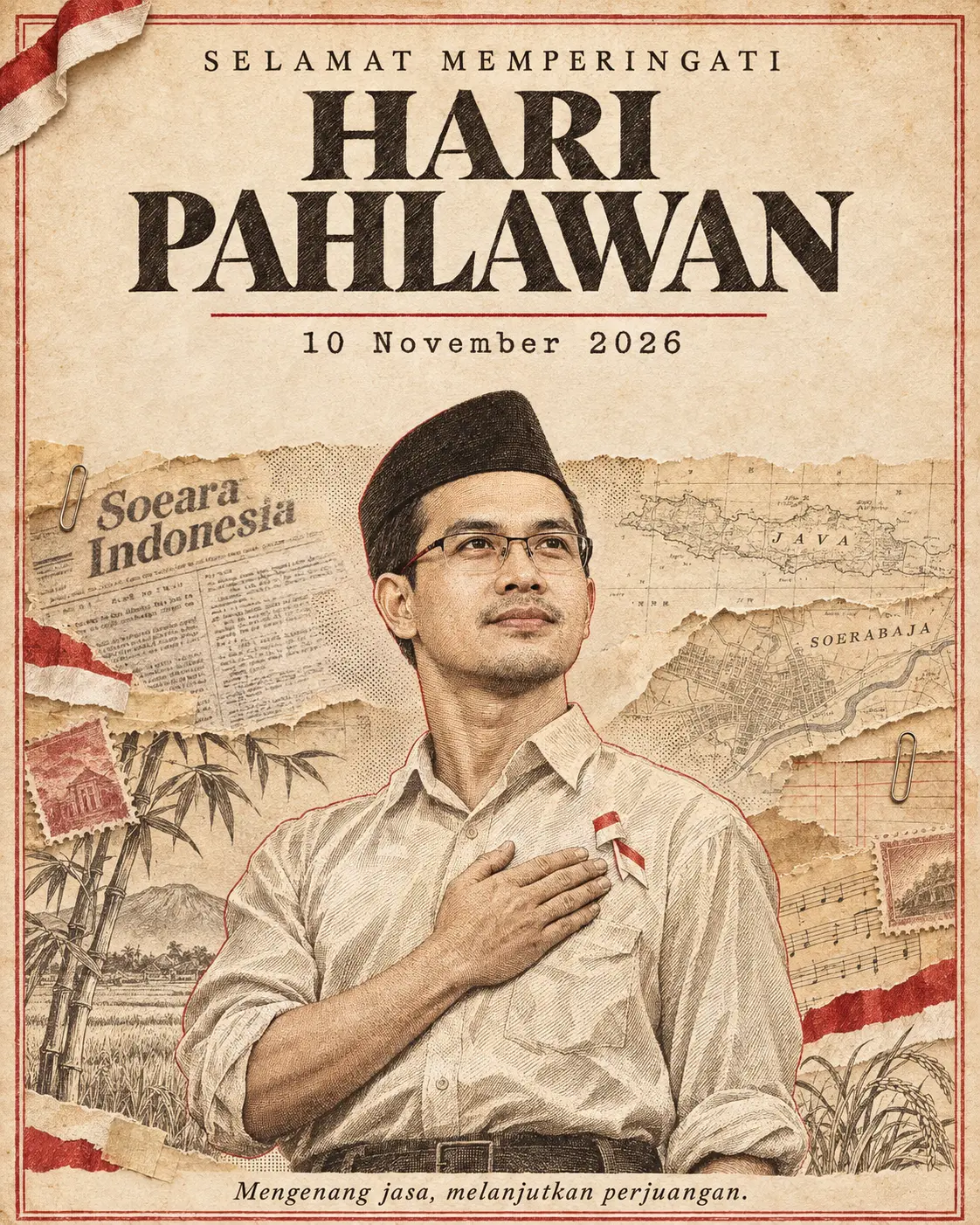
Transform the uploaded photo into a dignified commemorative poster for Hari Pahlawan, 4:5 vertical, designed like an official national-remembrance poster with the craft of a contemporary art-gallery print. It blends a 1945 newspaper archive with a richly layered mixed-media collage and a fine-line engraved portrait.

LAYOUT (strict, two separate zones): the poster is divided into a TITLE ZONE (top 35% of the canvas) and a SUBJECT ZONE (bottom 65%). The title zone is a clean aged-cream paper area containing only typography. The subject zone contains the person and all collage elements. The subject's head, hair, shoulders and hands must stay entirely inside the subject zone, with a clear visible gap of cream paper between the top of the head and the lowest line of the title text. Nothing from the subject, the collage or the illustrations may touch, overlap or cross into the title text. Text always sits fully on top of clean paper, never on the person.

FACIAL ANCHOR: the face, bone structure, identity and likeness must match the uploaded photo exactly, even in engraved form. Never pasted-on: harmonize light direction and head angle with the new pose and blend the hairline, jaw and neck into the collage so there is no visible cutout edge.

POSE: re-pose the person standing in solemn three-quarter view, upper body centered in the subject zone, one hand resting flat over the heart, chin slightly raised, gaze fixed on a distant point beyond the frame, shoulders relaxed yet upright. Crop the body naturally at the bottom edge of the poster.

EXPRESSION: quiet, deeply felt pride and gratitude, softened eyes with a faint glisten, lips gently closed with a hint of resolve. The emotion must feel alive and human, not stiff.

CLOTHING: 1945-era styling fitted to the person's gender. If a man: plain white shirt with sleeves rolled, dark trousers, black peci, small red-and-white pin on the chest. If a woman: simple white kebaya with dark kain, small red-and-white ribbon pinned at the shoulder. Natural fabric folds and wear, rendered through engraving linework.

ANATOMY LOCK: anatomically correct proportions, 5 fingers per hand, natural knuckles, thumb with 2 joints, 1:7 head-to-body ratio, natural shoulder width, arms reaching mid-thigh.

SUBJECT RENDERING (engraving effect): render the person as a classic line engraving in the manner of banknote portraits and 19th-century steel-plate prints. The entire figure is built from fine parallel hatching, cross-hatching and contour lines in warm sepia-black ink: lines swell and thin to model the face, cheekbones, eyelids and lips, curve along the forms of the clothing, and follow the folds of the fabric. Dense hatching in shadows, open sparse lines in highlights, with tiny stipple dots for soft skin transitions. Crisp, razor-sharp linework with slight ink spread, no photographic gradients, no blur. Add a very thin red-ink offset line along the outer contour of the figure. The face stays highly detailed and recognizable, with eyes clear and expressive.

BACKGROUND COLLAGE (rich, layered, deliberate, in the subject zone only): build a dense but harmonious collage behind and around the engraved figure. Layers from back to front: aged cream paper base with visible fibers and foxing; overlapping torn strips of faded 1945 newspaper (unreadable microprint only); fragments of old vintage maps of Java and Surabaya with fine grid lines and coordinates; pieces of old postage stamps and perforated edges (no readable text or dates); a delicate hand-inked line drawing of bamboo and Indonesian rice fields rising from the lower edge; torn sheet-music and ledger paper scraps; faint halftone dot patches in sepia; a few torn strips of Merah and Putih paper layered at the edges; scattered paper tape, small paper clips and soft paper-thickness shadows. Elements overlap at varied angles and scales, with the densest texture around the edges and slightly calmer space directly behind the head so the engraved face reads clearly. Warm cream, sepia and charcoal palette, with red only in thin lines, the small paper strips and the ribbon.

DETAILS: a small folded Merah Putih ribbon fragment sits in the top-left corner, outside the text area. A thin Merah red double rule frames the whole poster as an inner border with generous margins. No large flat red shapes anywhere. No date stamp and no round stamp.

TYPOGRAPHY (the commemorative message is the hero, in the title zone only): small tracked caps "SELAMAT MEMPERINGATI" at the top, then directly below a very large bold vintage serif headline "HARI PAHLAWAN" in charcoal, stacked in two lines ("HARI" / "PAHLAWAN") with tight leading. Beneath it, a thin red rule and a typewriter-style subline: "10 November 2026". At the very bottom of the poster, small italic serif: "Mengenang jasa, melanjutkan perjuangan." placed on a clean strip of cream paper or a calm area that does not touch the person's face or hands. Strong scale contrast and a tight typographic grid. All text spelled exactly as written, crisp, fully legible, with no extra words or letters.

MOOD: solemn, grateful, dignified, official yet artful, like a national memorial poster.

AVOID: any stamp or text reading "10 NOV 1945", subject overlapping or touching the headline, text over the face, large red circle or red sun disc, big flat red blocks, photographic realism on the subject, weapons, battle scenes, fake-looking filters, cheesy vintage overlays, heavy vignette, clip-art stars, glow effects, drop shadows on text, watermark, logos, extra fingers.