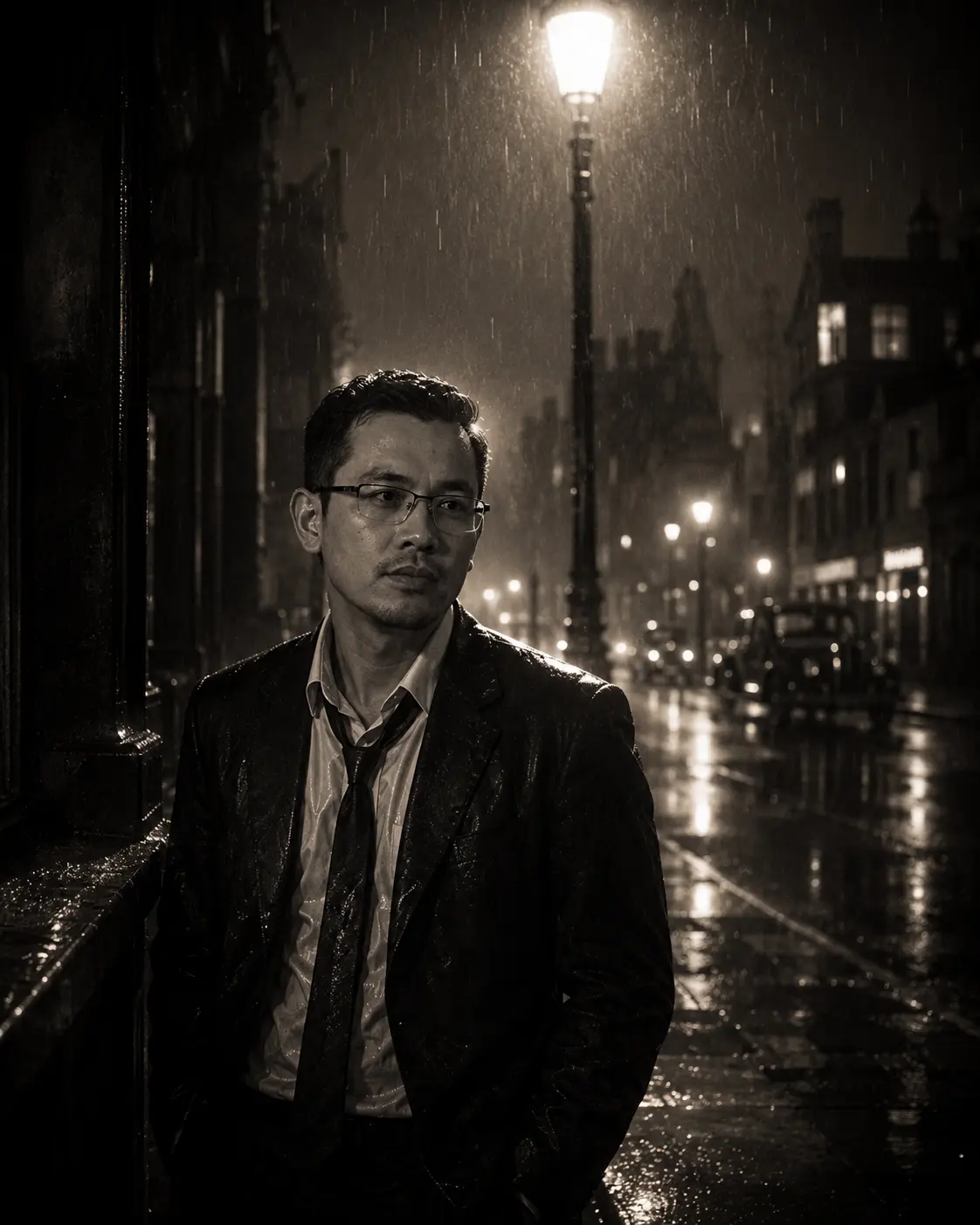
Edit this photo into a cinematic noir rain-street night portrait, matching this exact style:

IDENTITY LOCK: Keep the subject's face, facial features, identity, and proportions 100% unchanged — do not alter bone structure, eyes, nose, or mouth shape. Only restyle lighting, color, atmosphere, wardrobe rendering, and post-processing.

FACE INTEGRATION (critical): The face must blend seamlessly into the rest of the edited image — apply the same grain, lighting direction, shadow falloff, contrast, and tonal grade to the skin as the rest of the photo, so the face does not look pasted-on, over-sharpened, or artificially textured. Do NOT apply any separate skin-smoothing, skin-detail, or texture-enhancer filter to the face — the skin should carry natural film grain and soft shadow like the rest of the scene, not a distinct swirl/engraved pattern. The face should look like it was lit and shot within the same rainy night environment, not composited from a different light source.

LIGHTING: Replace existing lighting with a single hard rim/backlight source simulating a distant street lamp, positioned behind/above the subject to create a glowing hair-light halo and edge light on shoulders. Let most of the face fall into soft shadow with only gentle bounce fill, high contrast, low-key exposure, no flat frontal lighting.

COLOR GRADING: Convert to a mostly neutral grayscale black and white with only a very subtle sepia touch (\~10% tint strength) — the overall tonal range should read as monochrome, not clearly brown/warm, just the faintest hint of warmth in the highlights. High contrast, deep but not fully crushed blacks.

ERA & CONCEPT: Style the entire image after classic film noir cinema — think 1940s-1950s detective/crime film aesthetic: hard directional lighting, dramatic shadows, rain-slicked streets, trench coats, smoky urban atmosphere, timeless vintage setting (avoid modern signage, modern cars, or contemporary elements in the background).

ATMOSPHERE: Add a subtle rainy night city street background with soft bokeh street lights, wet reflective pavement, gentle mist/haze in the air.

POST-PROCESSING: Add a light, subtle film grain across the whole image (not heavy or noisy — just enough to feel like film, not digital), soft halation/glow bleeding around light sources, subtle dark vignette on the four corners, slight softness reminiscent of medium-format film print, shallow depth of field with blurred background.

WARDROBE (auto-detect subject's gender presentation from the uploaded photo and apply accordingly):

- If the subject reads as male: dress him in a dark tailored suit jacket over a white or light dress shirt with a tie, worn slightly undone/messy — collar loosened, top button open, tie loosely knotted and slightly crooked, jacket slightly rumpled, as if worn through a long rainy night. Not stiff or overly neat.
- If the subject reads as female: dress her in a dark oversized tailored blazer/coat in deep charcoal or black, minimal styling, no tie, optionally a thin layered necklace, worn slightly open at the collar.
  In both cases: fabric looks slightly damp from rain, hair looking slightly wind/rain-tousled.

MOOD & EXPRESSION: Preserve the subject's identity but change the expression to sad, weary, and forlorn — a hollow, distant gaze (tatapan nelangsa) as if lost in heavy thought, brows slightly drawn, mouth relaxed downward with no trace of a smile. Shoulders slightly slumped, posture tired and worn down, as if exhausted from a long, hard night — not a confident or composed stance. This must read as a candid, emotionally heavy street photograph, not a posed smiling photo, and not a studio headshot. Do NOT have the subject look straight into the camera with a frontal, symmetrical pose.

ANGLE & POSE (critical, do not skip): Turn the subject's head and body into a three-quarter angle — head turned about 30-45 degrees away from the camera, gazing off to the side into the distance, not directly at the lens. Camera angle should feel like it was shot from a slight distance across the street, not a tight frontal close-up.

COMPOSITION (critical framing ratio): Zoom out / pull the camera back so the environment dominates the frame — the night street scene (wet pavement, distant buildings, street lamp, rain, bokeh lights) should occupy roughly 60% of the frame, with the subject occupying only about 40%, positioned smaller and off-center within the wider scene rather than filling the frame as a close-up portrait. Portrait orientation (4:5), subject placed per rule of thirds, generous negative space of visible environment around them.

Output as a single cohesive edited photo, photorealistic, high detail, consistent grain and tone across the entire frame.